
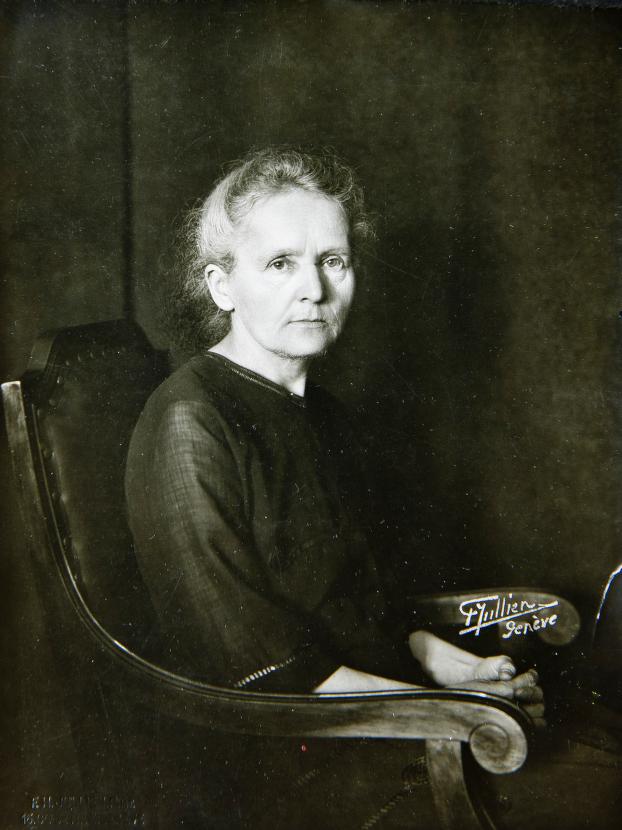
Marie Curie was born Maria Solomea Sklodowska in November of 1867 in Warsaw, Poland.
From an early age, Marie was known for her intelligence and excellent memory. She excelled at school but was forbidden to continue in higher education due to her gender.
Undaunted, Marie, along with her sister, Bronislawa, enrolled with the Flying University, an institution in Poland that allowed female students to study. They made a pact that Marie would fund Bronislawa’s medical studies in Paris, and when she was finished, she would help Marie do the same.
In 1891 Marie joined her sister in Paris, where she studied at the Sorbonne and earned degrees in physics and mathematical sciences. It was during this time that she met her husband and future research partner, Pierre Curie, who was a professor of physics. They married in 1895 and began doing research together.
Despite the worldwide acclaim they would later engender, the bulk of their pioneering research was done in a humble shack next door to the University of Paris.
Their shared curiosity and scientific background were the catalysts for their research into the invisible rays given off by uranium.
Their dedication paid off, and their research led to the discovery of the element they named Polonium, after Marie’s home country. To their surprise, they discovered that after extracting the polonium, the remaining liquid still contained high levels of radiation. In 1898, they discovered this remaining substance was a new element they would name radium.
They were rewarded for their efforts in 1903 when, along with their contemporary, Henri Becquerel, they were awarded for their efforts by winning the Nobel Prize in Physics. Marie would not have received the award if not for the efforts of her husband, as the committee did not want to acknowledge Marie because she was a woman. When Pierre received a letter of notification from them, he wrote back stipulating that Marie was as responsible for the discovery as he was, and insisted she also be a recipient. The committee capitulated and Marie became the first woman to receive a Nobel Prize.
As surprising at it seems, Marie and Pierre did not become rich from their discovery, as they refused to patent their process. They freely shared their research and methods with all who were interested. As a result, the cost of radium skyrocketed during a time known as the ‘Radium Boom,’ and by 1920 Marie, by then a widow, could no longer afford to buy the element she had discovered.
After Pierre’s death, Marie continued her work with radium, creating mobile x-ray units that were used on the battlefields of World War I.
Because of the dangers in the substances they were using for their research, both Marie and Pierre experienced extreme bouts of radiation sickness. Over a century later, researchers still must wear protective clothing when examining the Curie’s research papers.
In 1911, Marie was awarded a second Nobel Prize, this one in chemistry, and she became the first person in history to receive two Nobel Prizes.
Her legacy continued when, using her parents discovery as her foundation, her daughter, Irene Joliot Curie, was awarded the Nobel Prize in chemistry in 1935, making them the only mother and daughter to hold that honor.
Sadly, because of the effects of the poisonous substances she discovered, Marie died of aplastic anemia in July of 1934.
She was 66 years old.
 The damsel in distress...rescues herself.