
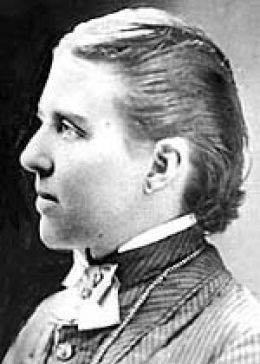
Arabella Mansfield was born Belle Aurelia Babb on her family’s farm near Burlington, Iowa in May of 1846.
Her family consisted of her parents and her older brother Washington Irving, with whom she shared a close and loving bond.
While still a young girl, her father left the family to work in California as a miner. Before he left, he made out a will leaving provisions for the education of his children.
Sadly, her father was killed in a mine collapse just two years after he departed.
After his death her mother moved with the children to Mt. Pleasant, Iowa, where the children garnered their education.
Because of her father’s foresight, there was money for the continuing education of both Washington and Belle, who by the time she entered college had chosen to go by the name ‘Arabella.’
She followed her brother to Iowa Wesleyan University, where she graduated in 1866 as the valedictorian, while her brother was salutatorian.
Her brother became a lawyer, and Arabella was an apprentice at his firm. It was while working there that she married her college sweetheart, John Mansfield, a professor of natural history at Iowa Wesleyan.
In 1868, Arabella joined her husband as a faculty member at Iowa Wesleyan, teaching English and history.
While teaching, they also studied law together, and in 1869 they applied to the Iowa bar for admission.
Arabella passed the bar exam on June 15, 1869. She did not automatically get admitted to the bar association, however, as the written law stated only ‘any white male citizen’ was able to become a lawyer.
She argued passionately and intelligently in her own defense, convincing the presiding judge that there was no law forbidding women from becoming lawyers. She was so persuasive in her argument that it prompted the judge to write, ‘Your committee takes unusual pleasure in recommending the admission of Mrs. Mansfield, not only because she is the first lady who has applied for this authority in this state, but because in her examination she has given the very best rebuke possible to the imputation that ladies cannot qualify for the practice of law.’
Because of her efforts, in 1870 the law was amended to remove the words ‘white male.’
Arabella was also a staunch advocate for women’s rights, giving lectures and becoming a champion for women’s suffrage and helping to found the Iowa Woman Suffrage Society.
Though she is recorded as the first female lawyer in the United States, she never practiced law, preferring teaching instead. She had a successful career in academia at both Iowa Wesleyan and DePauw University, where she taught until her death in 1911.
 The damsel in distress...rescues herself.